Music Teacher Marketing: How Independent Music Teachers Can Reach More Students through SEO
Learn practical music teacher marketing strategies to attract more students online using SEO, Google Business, and proven visibility techniques.
 Elijah Baker
Music teacher marketing is difficult for most musicians. It is certainly not a topic taught in music school. As a music teacher with over 15 years of experience, I am also the founder of Musiprof, an online platform that helps students find qualified music teachers. Over the years, I’ve learned many invaluable lessons about building visibility online. In this article, I’d like to share some of these hard-earned insights with fellow Canadian music teachers.
Optimize Your Website for Search Engines, Not Just Social Media
Having a website optimized for discovery on search engines like Google is one of the best ways for new students to find you online. This process is known as SEO (Search Engine Optimization), an often-overlooked aspect of music teacher marketing.
When students are actively looking for lessons, the first place they usually go is Google, not social media. Searches like “music teacher near me” or “piano lessons in Montreal” have clear intent to book lessons.
Many teachers focus primarily on posting photos and videos to social media, but those posts are generally only seen by existing contacts or followers. By contrast, search engines connect you with people who are actively seeking a teacher, which is a much warmer audience.
Geolocation and Setting Up Your Google Business Profile
According to research, roughly 46% of Google searches have local intent. That means users are looking for services in their geographic area. When Google detects local intent, it shows a map pack, local business listings, at the top of the results.
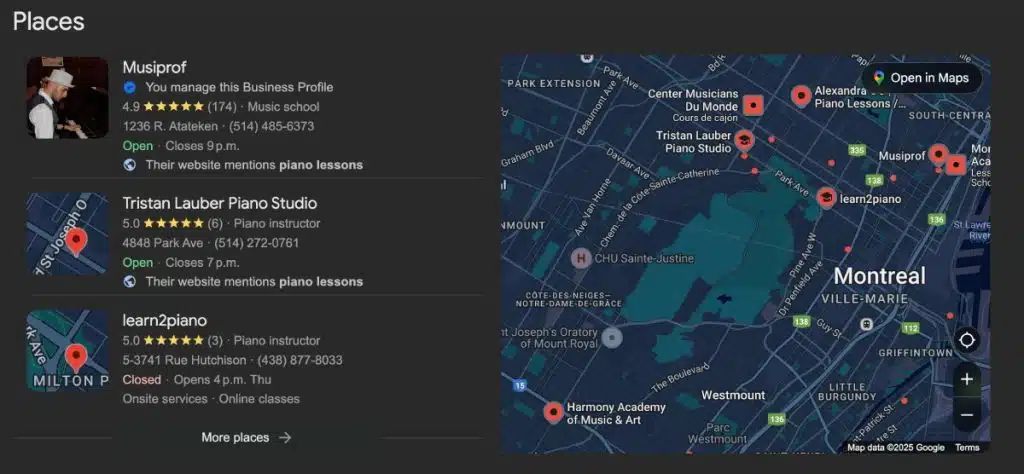
To appear here, you’ll need to set up a Google Business Profile. Be sure to include your contact information, teaching hours, a website link and some professional photos. Encourage your satisfied students to leave reviews, since this is one of the main factors that helps your listing appear higher in local search results.
Include Relevant Keywords
In your profile, use relevant keywords such as “music teacher”, “guitar lessons in Toronto”, or “violin teacher in Vancouver.” You can also include specialized techniques that make you unique (for example, Suzuki method, Alexander technique, or jazz improvisation).
Optimize Your Website for the Right Keywords
The same keywords you add to your Google profile should also appear strategically on your website. Follow the golden rule of SEO: one main keyword per page.
Many teachers make the mistake of trying to optimize one page for multiple topics. Instead, dedicate each page to a single keyword or intent.
Include Your Keyword in the Page Title
Let’s take the keyword “music teacher in Montreal.” Instead of titling your homepage with your name, add your target keyword next to it. For example: Elijah Baker — Qualified and Experienced Music Teacher in Montreal.
This way, you’ll appear both in searches from people who already know your name and from those simply looking for a teacher in your area.
Keyword Density
Sprinkle your target keyword naturally throughout your page. For instance, in the first paragraph of text on your page, write something like:
“Are you looking for a music teacher in Montreal? Let me introduce myself…”
A density of around 1–2% (target keyword ÷ total word count × 100%) is ideal. Overusing the keyword is known as keyword stuffing and can harm your SEO.
Use a Free Keyword Research Tool for Music Teacher Marketing
You can sign up for SEMrush’s 7-day free trial, one of the best keyword research tools for music teacher marketing. Identify which keyword variations have the highest search volume in Canada. After seven days, you can simply let the trial expire.
Create Specialized Pages or Blog Articles
Once you understand the “one keyword per page” principle, create dedicated pages for your areas of expertise. For example, if you’re a violin teacher specializing in the Suzuki method, create a page targeting “Suzuki method violin.” This term is searched around 30 times per month in Canada and 700 times worldwide.
Highlight Your Expertise
On this page, showcase your expertise by including images, PDFs, and helpful resources (such as guides or recommended books). You could also embed short instructional videos that double as practice aids for your students.
Add Keywords in the Page URL
Most website platforms allow you to customize URLs – another important ranking factor. For example:
mymusiclessons.com/suzuki-method-violin
Tip: Share your new article on your Google Business Profile and social media accounts to increase visibility.
Why You Have a Better Chance of Standing Out on Search Engines
Search engines like Google reward websites that demonstrate E-E-A-T, which stands for Experience, Expertise, Authoritativeness, and Trustworthiness.
Websites that clearly show these qualities in their content are rewarded with higher rankings. As qualified music teachers, you already possess these attributes, you just need to highlight them effectively online.
Let’s look at how each applies to you:
Experience
Talk about your teaching experience in your content. Write about specific teaching challenges and how you overcame them, or reference particular books and resources that have worked well for you. You can also include videos demonstrating techniques or songs related to your lessons, these showcase your real-world experience.
Expertise
Share what makes you particularly qualified. Mention the institutions where you studied, the teachers you’ve learned from, or any certifications you hold.
This can be placed in your introduction, an author bio, or your About page.
Authority
Authority is mainly built through signals outside your website. Google gathers information about entities (people and organizations) from across the web to validate the authority of authors. For example, having a detailed LinkedIn profile, being featured in press articles, or earning mentions from authoritative institutions like music schools or professional associations (e.g., the Canadian Federation of Music Teachers) all strengthen your authority.
Trust
Trust is most effectively built through verified third-party reviews. Google favours reviews published on external platforms like Google Business, Yelp, or Trustpilot. Since those can be verified. Reviews that appear only on your website don’t carry the same weight because Google can’t confirm their authenticity.
In Conclusion
Getting your website noticed on search engines is one of the most powerful ways to develop your music teacher marketing, your online visibility and attract new students. This approach can be applied for in person lessons by targeting local searches, but also for students looking for online lessons. Additionally, joining a network like Musiprof can be a great way to enhance your online visibility also. If you’re a qualified and experienced music teacher, don’t hesitate to apply to join our teacher network.
By combining practical SEO techniques with your natural experience, expertise, authority, and trust, you can build a lasting digital presence that brings new opportunities and helps more students discover your teaching.
About the Author: Elijah Baker

Elijah Baker is the founder of Musiprof.com, an established platform for music teachers in Montreal and select cities across Canada. He has over 15 years of teaching experience, has worked with hundreds of students, and currently teaches a college-level course on Search Engine Optimization at Cumberland College in Montréal, Quebec.
FAQ
Can I make a living as a music teacher?
Most musicians prefer to view music teaching as a secondary source of income. The prefer to balance professional gigs and recording projects with teaching music rather than doing it full-time. That being said, if you enjoy teaching, then it is possible to earn a steady income from it. Read our article on music teaching jobs, which covers the different teaching opportunities available for independent music teachers.
How much for a 1-hour music lesson?
Music teachers should set their prices based on their level of education, teaching experience and location. For example, the GMMQ (a Montreal based professional musicians union and a Musiprof partner) recommends the following pricing for music lessons based on the musician’s Education Level
Minimum Base Fee
Level A – College Diploma (DEC) or less than 10 years of experience
$39.00 /H
Level B – Bachelor’s Degree or less than 10 years of experience
$45.00 /H
Level C – Master’s Degree or 10 years and more of experience
$52.00 /H
Level D – Doctorate or 10 years and more of experience
$77.50 /H
What are music marketing strategies?
One of the best marketing strategies for music teachers is SEO. Many music teachers focus mainly on promoting themselves on Social Media. This is a mistake, since they never reach beyond their network. SEO allows music teachers to position themselves as an authority and get found for local searches.
What are the 5 strengths of a teacher?
According to the Musiprof article “How to Teach Music – 10 Ways to Keep Your Students Inspired,” an effective music teacher demonstrates both professional and personal strengths. Professionally, they motivate students by centring lessons around songs they love, providing clear and achievable goals, making learning feel accessible, building genuine relationships, and connecting theory to real musical practice. Personally, they embody patience, empathy, open-mindedness, positivity, and an authentic passion for music—qualities that inspire trust and long-term engagement in their students.
Published on Musiprof