9 Awesome Paradiddle Variations: The Ultimate Guide
Learn how to master paradiddles. Includes 9 important paradiddle variations to get your technique on point. Free demo videos & PDF download.
 Elijah Baker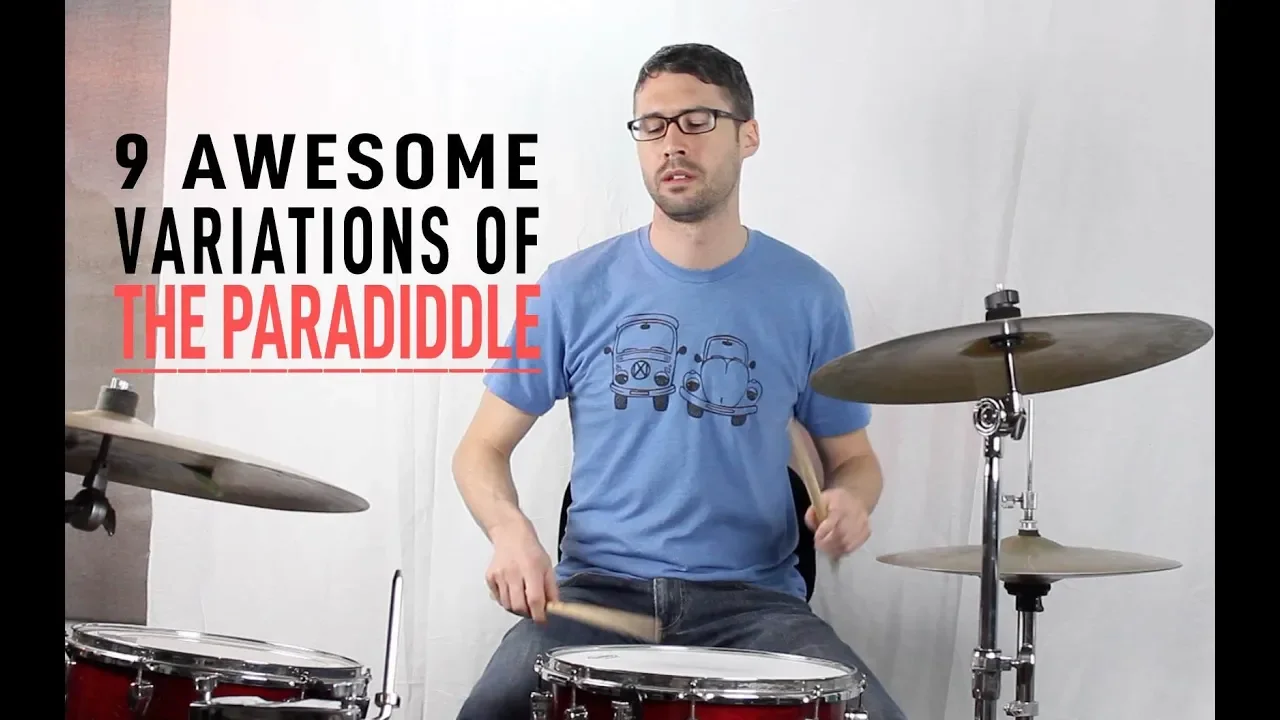
Why learn paradiddles and variations?
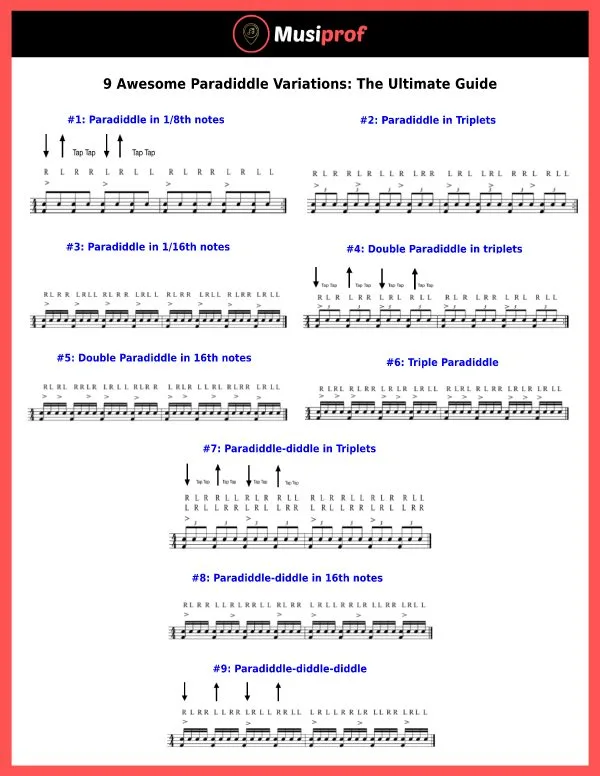
This guide includes 9 paradiddle variations for beginner to advanced drummers. Beginners can try playing variations #1 and #3, while more advanced players can work on the rest of the variations. Try working through these on your own by downloading the free PNG and working through each variation using the videos embedded below.
It's important to develop your technique fundamentals to master your paradiddles:
Check out my moeller technique course on Udemy
9 Fundamental Paradiddle Variations:
#1 Paradiddles In Eighth Notes
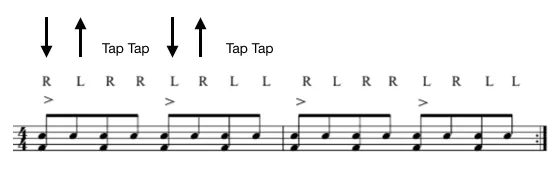
The first way to play paradiddles is in eighth notes. The sticking is right-left-right-right, left-right-left-left. I play these examples using the German grip as well as the French grip, but they can also be played using any other type of grip (e.g., American, Traditional, etc.). I like to begin teaching paradiddles in French grip because it is the grip with the easiest access to understanding rebound and finger control.
There are 3 types of movements I think about when I play: down strokes, up-strokes, and tap strokes. The down-stroke will allow you to get a louder accent on certain beats. The up-strokes and tap strokes are softer, so their purpose is to fill in. Aim to "control" the accent on the down-stroke (i.e., don't let the stick bounce out of control after the impact).
German grip:
French grip:
Note: Notice the form that I'm using when I play paradiddles. This is crucial for playing paradiddles with flow and control. To master your form, try my Free Moeller Technique mini course.
Try the full Online Moeller Technique Course on Udemy for a lifetime
#2 In Triplets
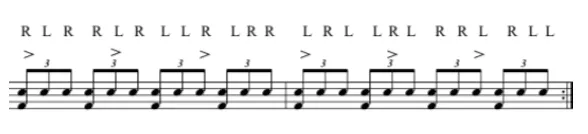
Once you are comfortable with 8th notes, you can challenge yourself to this next challenging variation. Because paradiddles are in groups of 4 notes, when you play them in triplets (3 notes), they no longer line up perfectly with the beat. Stay concentrated on keeping your movements consistent (with the same sequence of down-strokes, upstrokes, and tap strokes as before). Use the sheet music to help you identify exactly where the beat falls within the exercise.
Triplets - German Grip
Triplets - French Grip
#3 Paradiddles In 16th Notes
Now that we are comfortable with these previous variations, we can try to play a little faster in 16th notes. 16th notes are mathematically twice as fast as eighth notes, so it’s pretty natural to simply double the speed as we switch from 1/8th notes to 1/16th notes. Again, keep the movements the same as before, however, you can turn your attention to allowing the down stroke to "pivot" freely to maintain the momentum of the moving stick.

German Grip
French Grip
Pro tip: In order to increase your speed, split your hands up and practice each hand individually. Let the first stroke "pivot" and "rebound." Allow the two doubles to simply be a reaction to the initial accent. Using this rebound, the paradiddle becomes one big movement with rebounds, rather than 3 individual strokes.

Try the FREE Moeller Technique Mini-Course
#4 Double Paradiddles in Triplets
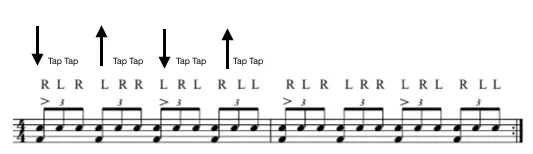
For this variation, we simply add two single notes at the beginning of each paradiddle. These 2 extra notes transform the pattern into 6 strokes. Therefore, playing them in triplets works very well. The sticking now becomes right-left-right-left-right-right & left-right-left-right-left-left. Sometimes I call this variation para-para-diddles. The para represents the single and the diddle represents the doubles.
German Grip
French Grip
#5 Double Paradiddles in 16th Notes
You can also play double paradiddles in 16th notes; however, to make it fit in 4/4 time, you need to add a single paradiddle at the end.
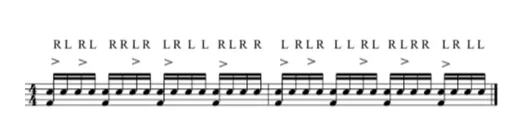
Double Paradiddles in 16th notes
#6 Triple Paradiddles
This one is similar to the previous variation but with 3 singles followed by a double. This rudiment is made up of 8 notes, which works perfectly in 16th notes and fits easily into a bar of 4/4 time.
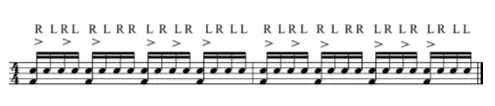
Watch: Triple Paradiddles
#7 The Paradiddle-diddle in Triplets
This variation consists of adding an extra double at the end of the paradiddle. The sequence is now right-left-right-right-left-left. Again, this gives a 6-beat pattern, so it’s great to practice in triplets. It’s a good idea to practice leading with the left hand as well because this variation doesn’t naturally change hands.
The up-stroke is now placed on the second double.
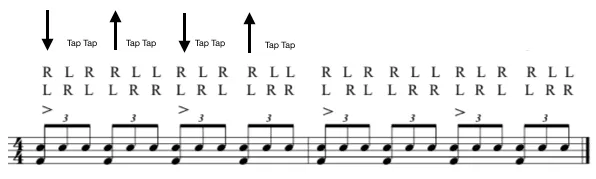
Paradiddle-diddles - Triplets
#8 The Paradiddle-diddle in 16th Notes
It is interesting to play paradiddle-diddles in 16th notes as well. Here we add a single paradiddle at the end of the measure for it to fit into a bar of 4/4 time.

German Grip
French Grip
#9 The Paradiddle-diddle-diddle
The last of the variations adds a third double or diddle. The sticking is now right-left-right-right-left-left-right-right. What’s great about this variation is that it has 8 strokes and therefore fits perfectly in 16th notes in a bar of 4/4 time. It also naturally alternates from the right-hand to the left-hand lead.
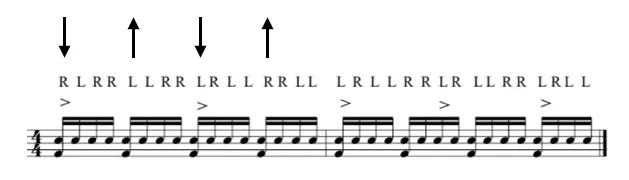
German Grip
French Grip
In Conclusion
Once you are comfortable with each of these variations, a great exercise for mastery is to practice reading the sheet down at 70-90 B.P.M. (metronome speed), playing each line consecutively with one repetition only.
Top Drum teachers in Canada (online)



About the Author
Elijah is a university-educated drummer with extensive experience in both teaching and musical performance. Since completing his Bachelor of Music degree at Concordia University in 2010, he has played music across each province in Canada and in more than 20 countries around the world.
About Musiprof
Musiprof is a Canadian Music organization that connects drum teachers to students in Montreal, Toronto and Vancouver.
Published on Musiprof